
Washington County Bench Warrants Explained
A bench warrant grows out of a required appearance or some other order a court has already made, and in Washington County the court that owns the case decides how it is handled. General Sessions takes many state misdemeanor, traffic, and preliminary-hearing matters. Criminal Court takes felony cases after bind-over or indictment. Johnson City and Jonesborough each run their own municipal dockets for ordinance and traffic cases. Missing a date does not reveal the exact process or the fix. The official form has an FTA/report-to-jail checkbox, but the judge chooses among a warrant, capias, reset, bond action, or another order. One habit prevents wasted trips: call the clerk named on the notice before you travel or pay anything.
Washington County Bench Warrants Follow Court Captions
Routing a Washington County warrant question starts with the notice or citation in hand, because the caption tells you which court to call. General Sessions state matters go through the Sessions docket contact. A felony indictment or presentment belongs to Criminal Court. A Johnson City ordinance citation goes to its municipal clerk, and a Jonesborough summons belongs at the town court inside Town Hall. Juvenile records are restricted. Only an authorized parent, guardian, or party should raise them. There is no justice-of-the-peace precinct system here, so skip the Texas-style JP office that Washington County does not identify. When a paper says only "county," ask the clerk or WCSO which docket owns the process. The General Sessions court page lays out the state-court route.
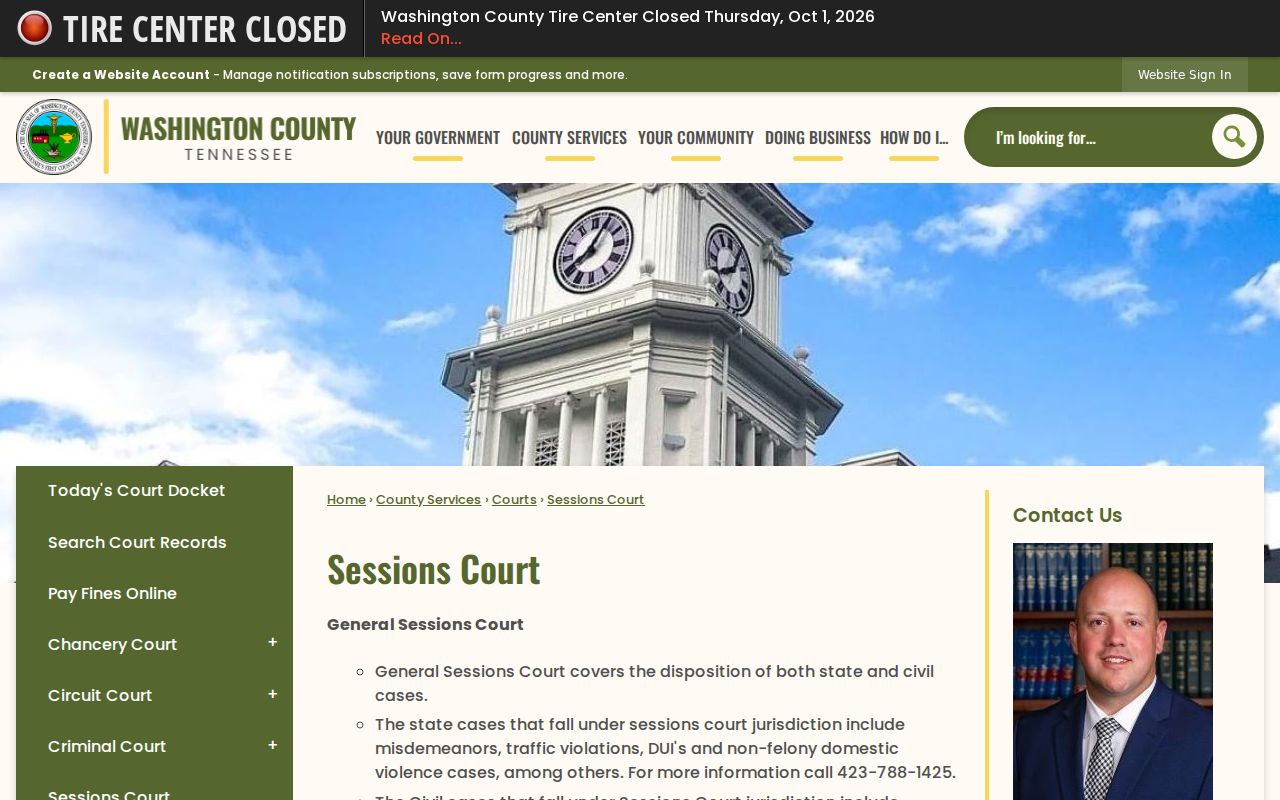
The Washington County Sessions page describes the court's role and how to reach it; the issuing court itself confirms any particular case.
How Washington County Bench Warrants Are Issued
In Washington County, a judge or another authorized judicial officer makes the bench-warrant call. A missed setting, a failure to report to jail, bond or release noncompliance, contempt, or another court order can each prompt process, depending on the case. Rule 9 capias works differently. After an indictment or presentment, the clerk issues a capias or a summons in the situations the rule names. The difference matters. An original probable-cause arrest warrant and a later capias can both command an arrest even though they arise at different stages of the case. Washington County publishes no single local code table and no universal FTA recall rule.
Washington County Bench Terms Need Clerk Review
"FTA" means failure to appear at a required court or jail setting. In Tennessee, a "capias" generally refers to Rule 9 arrest process after indictment or presentment. "Recall" means the Washington County issuing court withdraws the process; "quash" means the court sets it aside. No word alone tells you whether a new court date or bond condition still stands.
- Bench warrant
- Court process linked to a missed appearance or noncompliance.
- Capias
- Rule 9 process directing arrest and return to court.
- Returned
- An officer has sent the process back to the court, served or unserved.
- Recalled
- The court has withdrawn that process; confirm the order and next setting.
Ask the Washington County clerk to translate the entry on the local docket. A status word can carry a different meaning in every system, so never assume.
Bench Warrants and Arrest Warrants Compared
Both kinds of paper can authorize an arrest, but the event behind them differs. A complaint plus probable-cause review may produce an original arrest warrant. A Washington County bench warrant grows from a court obligation already in progress. A capias follows indictment or presentment under Rule 9. A summons can direct a person to court without an immediate arrest.
| Process | Common trigger | Office to ask |
|---|---|---|
| Arrest warrant | Probable cause in a complaint | Issuing judge or clerk |
| Bench / FTA process | Missed setting or order | Court that set the date |
| Rule 9 capias | Indictment or presentment | Criminal Court clerk |
In Washington County, the caption and the case stage guide the call. The process label alone does not say the charge is resolved.
Washington County FTA Paths Differ by Court
Johnson City Municipal Court handles city ordinances, speeding, traffic, and code matters. Its court materials list a recurring Tuesday evening session on the first and third Tuesdays, plus Monday and Wednesday morning sessions. The citation still controls the actual date. Jonesborough goes its own way. Its code makes failure to appear on a town summons or citation an ordinance violation in itself. These local rules cannot be collapsed into one Washington County FTA process, and a county search does not offer either municipal court as a court-type choice. Call the court named on the citation to ask what order was entered. The Tennessee criminal rules index holds the Rule 4 and Rule 9 procedure referenced here.
Resolving a Washington County Bench Warrant
First, ask whether the Washington County court shows a bench warrant, capias, FTA, failure-to-report order, or bond forfeiture. Then ask whether the judge requires a motion, attorney appearance, reset, scheduled surrender, or a new setting. The county publishes no recall form, filing fee, universal payment plan, or walk-in clinic.
Call before appearing. The detention center is a custody facility, and public materials do not promise an unscheduled surrender window or same-day recall.
If a Washington County court directs you to surrender, get the location, timing, identification rules, and bond instructions from the court or your counsel. Keep any order or receipt. Ask when the docket will show the action.
Questions for a Washington County Bench Warrant Call
Before calling about a Washington County bench warrant, gather the name as printed on the notice, the court date, the case or citation number, and the court caption. Ask what event led to the process, whether it is still outstanding, what bond and conditions apply, and whether counsel or an in-person appearance is required. If the clerk cannot speak with a relative, ask what authorization is needed.
- Which court issued this process, and what kind is it?
- Was it served, returned, recalled, or replaced?
- What action will satisfy the current order?
- What paper or docket entry will confirm the result?
A Washington County clerk call can identify the next step, but only the issuing court can recall a warrant.
Finding the Court That Issued the Warrant
Every Washington County warrant traces back to a specific court, so that is the office to call. The Tennessee criminal rules lay out arrest-warrant and capias procedure, while the county's own court pages describe the local divisions. For the General Sessions state docket, dial 423-788-1425. Criminal Court answers at 423-753-1612. Johnson City Municipal Court sits at 423-434-6160, and Jonesborough Municipal Court at 423-753-1053. The Circuit Court Clerk's line is 423-753-1736, though county pages disagree on who currently holds the office, so confirm by phone. One caution: don't mistake the County Clerk's administrative office for a court clerk, don't treat WCSO booking pages as a docket, and route civil or probate questions to the Chancery Clerk & Master.
What a Washington County Bench Warrant Call Should Establish
Before you dial about a Washington County bench warrant, know what to ask. Bond forfeiture is its own court question, separate from whether a bench warrant stays active, even when a missed appearance and a surety are both involved. Ask the clerk for the operative order. Ask about any bond condition. Ask about the next hearing date, and whether a surety or Driver Services step plays a part. Washington County publishes no countywide bond schedule. Afterward, keep checking back. Once a reset, payment, appearance, surrender, or recall happens, contact the issuing clerk again, because the county does not publish any update cadence for its court and law-enforcement systems. Hold on to the written order, too, since a closed case entry does not guarantee that every piece of process has been cleared.